Middle Schoolers’ Endstate

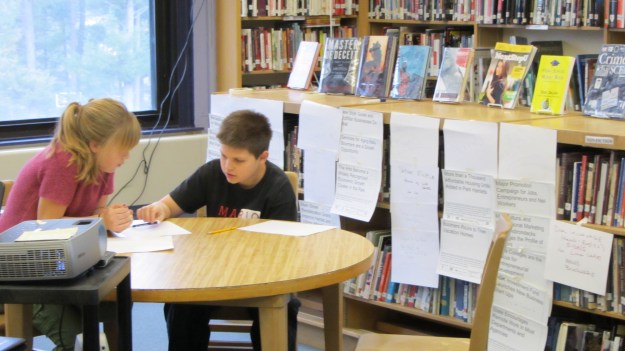
Earlier this month we had the pleasure of facilitating two half-day workshops with the 7th and 8th graders at Long Lake Central School.  The process we used was really the idea of the teachers there.  For the first session, we worked with the students to imagine what a future endstate for their community and school could look like.  We also looked at some of the broader possibilities for the Park as a whole.  For the second session, we had the students think about what events would have to happen to make their endstate come about.  At the end, we asked them to think about the ways in which they could participate in making three of those events happen some day.  The teachers are going to continue working with the students to help them understand what they have to learn during their time in school in order to be able to make those contributions.
IMG_0220

The students were thoughtful and creative and easily engaged with the major issues, such as balancing environmental protection with developing the local economy.  They also wanted more local control and less imposition of rules by people who live outside the Park.  This is the endstate that they came up with.

Long Lake and the Adirondack Park in 2028

A Stronger, More Vibrant Community

More jobs, residents, and families,

A bigger hamlet with a new neighborhood, more buildings

More visitors and retirees, who create jobs by spending money in the community

More jobs in agriculture, logging, light manufacturing, healthcare and using the broadband network; maybe a community college

More services: stores, bakery, restaurants, movie theater, arcade, retirement home, cellphones

Using Greener Energy and Less Fossil Fuel

More renewable energy like solar, wind, hydro and biomass based on wood pellets; the conversion to renewables will generate jobs and save money in the long run

Waste less energy and save money

More electric and hybrid cars, more use of synfuels, especially as gasoline gets more expensive

Revive the rail system

More biking, walking, ride sharing so you use your car less

Government and Adirondack Park policies that support renewable energy including wind turbines

With Smaller, More Local Government

Less waste and duplication.  Share government positions with other towns in the county (e.g., tax collector, highway supervisor, coroner, town and school boards).

More local control: People who live in the Park should have the say over the rules in the Park.  Lessen the role of the APA and let local communities regulate and enforce laws in their own towns.  Let towns modify hunting regulations.

Cut through the red tape and be more self-reliant.  Government that this friendly toward economic growth, that promotes good projects and helps then succeed.

A little bit bigger school that is more diverse, and shares resources with neighboring schools

And That Protects the Environment

Adirondack waters need more protection from invasive plants and animals, storm water runoff from farms and lawns, and leaking septic systems

The Park is large and can support many kinds of recreation, some wild and some not, some with and some without motors.

The people of the community want to protect the waters and forests and wild life of the Park from pollution and over use. Responsible hunting, fishing and logging don’t degrade the environment.

The Role of Manufacturing in the ADK Futures Strategy

A couple of times now when we give our standard talk about the ADK Futures project and the consensus vision, someone asks us why there is no manufacturing in the plan. Although it doesn’t receive strong emphasis, there is mention of manufacturing in the vision.  In the 45 minute version  of the talk it often gets dropped.  But it actually is a big deal.

Many of the areas just outside the Blue Line are experiencing a manufacturing boom.  The Saratoga/Capital region, in particular, is experiencing an incredible high-tech boom in nanotech and semiconductors.  There is the potential for much further expansion there, too.  Meanwhile there is expansion at Bombardier in Plattsburgh and the Army in Ft. Drum and Fage Yogurt  south of the Park in Johnstown. International Paper’s Ticonderoga Mill is in the Park, producing copier and office printer paper. The Finch Pryun mill in Glens Falls produces also produces printing paper.

There are many ways in which the edge towns of the Park that are near these growing areas can benefit from this mini-boom.  Some employees in these new or expanding plants will choose to live in a quieter community with more open space somewhere just over the Blue Line in the Park. Others will want vacation homes in the Park.  Most will at least visit regularly.  The management of some of these new companies in the region may decide to build a Corporate retreat somewhere currently up for sale.  Notice I haven’t even mentioned fracking and its potential economic impact on the southern areas of the Park?

People throughout the Park with broadband Internet access will also be able to participate in various ways in the growth in manufacturing and other jobs in the ring of cities around the Park, as subcontractors and remote employees, or as providers of necessary business back office services.  People can work from home, but also easily show up in the office when necessary.  Some smaller subcontractors may find it cheaper to set up shop in an Adirondack town than in the booming capital region.  With most business interactions being over the Internet anyway, you don’t have to be co-located in the same office Park as your client.

All of this requires getting in front of the people who are hiring and growing these businesses around the edges of the Park in order to promote the region as a place to live, vacation and recreate. Some of the community development organizations around the Park are working on this we’re told. We need to dispel the myth that a business can’t get started inside the Blue Line because of APA and DEC red tape and restrictions. We have industrial parks, waiting. We have a large industrial site in Clifton Fine with fiber trunk line and potentially restored rail freight service.  Information businesses, in particular, should raise no serious environmental concerns.

Inside the Park, we have some light manufacturing that can grow.  Here are some examples. Saranac Lake has several biotech companies.  North Creek has Creative Stage Lighting doing well enough to expand.  In Willsboro, General Composites is a custom manufacturer of hi-end composite components. In Piseco, Wilt Industries fabricates advance annealing ovens to produce, for example, silicon ingots for chip companies like Intel.  Placid Boatworks makes canoes.  Hi-end craftsman make rustic furniture, guide boats and taxidermy.

These are niche businesses.  “Niche” means they are large enough to be real businesses, but their markets don’t attract the 1000 pound guerrillas of industry.  These fit the Park better than large mines and mills, employing many hundreds of people.  When these big business fail or leave, the towns involved crash, often losing 2/3 of their population.  Look at Port Henry, Newcomb, Clifton-Fine – all are case studies.  The Trudeau Sanatorium in Saranac Lake was a huge employer and shut abruptly in the summer of 1954 when effective antibiotics were introduced.  It took decades to the village to get back on its feet.  Light manufacturing, involved in niche markets, is our sweet spot.  But you have to find a lot of them.

Biomass: Some Hype, Some Hope

Usually when the topic of biomass comes up in our various discussions around the Park, everyone is gung ho and nod their heads positively.  Biomass is an important component of the ADK Futures strategy for both lowering our carbon footprint and keeping employment in the forestry sector.  It is also an important component of the North Country Regional Economic Development Strategy.  The Northern Forest Center also has made biomass heating a focus of new market development.  We are told that there is a lot of interest in biomass as a renewable, low net carbon contribution fuel source at the State and Federal level.

So, how big is this new market and how does that compare to our forest’s production?  There are a few researchers who have been looking at the numbers and one we have recently talked with is Dr. Charlie Canham, who is a Senior Scientist at the Cary Institute of Ecosystem Studies in Millbrook, NY.  Charlie’s detailed work looks at like available supply and at the efficiency with which various kinds of wood supply can be converted to energy of various types. He looks are the entire Northern Forest; State level detail is the best available.  Charlie concludes that, regionally,  only very modest portions, in the 5% range, of most energy markets could be met through biomass fuels, but there are a few that could be more significant. One that is promising is using biomass for heating.  Specifically, base load heating for larger buildings like schools, government offices, prisons, etc.

Because pulpwood prices are so low, and our available wood supply is not sufficient to substitute a lot of fossil fuel, Charlie worries that a real boom in biomass might lead to unsustainable harvesting of forests and that would negate much of the carbon emission benefit of the fuel.  The image of trains loaded with pellets leaving the region come to mind, but it is never going to happen.  Pipeline natural gas will keep the use of biomass contained to areas like the Park with plenty of wood and no gas pipelines.  Also, there are other government estimates that are higher than Charlie’s. So we’re not currently worried about over using our working forest.

The proposed use of biomass in the ADK Futures strategy is actually pretty limited.  We propose to focus on converting from fuel oil to biomass heating systems in the Park using the modern gasifier furnaces that emit little in the way of smoke and pollutants.  We propose to meet the heating needs of the 130,000 people and large buildings within the Blue Line.  Most of the Park is never going to get gas lines, and this makes it a good market for locally sourced biomass as a heating fuel.  The idea that train loads of pellets with head from the region to replace coal in power plants is never going to happen, but biomass will be a great low cost local heating fuel for Park residents.

Using biomass for electrical power production in co-gen facilities is a good thing, but it isn’t likely to do well in plants just generating electricity and dumping the heat – it is too inefficient to compete with hydro power capability in our region.  The ReEnergy project at Ft. Drum is a large 60 Megwatt power plant.  It was built as a coal fired co-gen plant but the steam distribution part of the system failed and has been abandoned.  It will burn wood, including whole tree chips, wood waste from sawmills, crop fuels like willow, and other material like shredded tires. It will probably be a one-of-a-kind facility in the region, although the company has a dozen plants burning various fuels elsewhere.

The other point that Charlie and we agree on is that it is reasonable, over the next 25 years, to expect one or both of the two remaining pulp mills in the region will close.  Their closure won’t be for lack of wood, but for the decline in printing paper markets.  We will need new pulpwood markets just to keep the current logging industry in business.  Luckily biomass heating using pellets requires the same pulpwood now going to our two pulp mills (Ticonderoga and Glens Falls).   We need these markets to buy our low value trees, leaving higher value trees to grow into saw logs for later harvests. Think of these markets as providing funding for weeding our forests periodically.

The best feed stock for biomass heating is pellets produced from pulpwood, not debris from logging operations.  There is an argument that it is best to leave logging debris on the forest floor as the carbon is better sequestered that way and the material decays to provide nutrients for the next generation of trees. It is ugly, but most forest operations are ugly. Removing the entire above ground biomass of a forest may look better, but is not as healthy for the forest.  Finally, logging waste makes lousy dirty fuel and it is expensive to collect.

If the pulp mills close, we can imagine the possibility of re-purposing a pulp mill to synfuel production, similar to ethanol from corn, but that is a long way off.  So, it feels like expanding biomass heating in the Park now is a good way to get us on the path to continued productive use of our working forests in renewable, low carbon energy markets of the future.

There is going to be temptation for many land owners along the way to deviate from sustainable harvesting practices.  Some may be unwise enough to let saw logs get diverted into energy.  The industry, DEC and NYSERDA need to think now about the kinds of monitoring programs that will need to be in place to warn us that we are loosing the carbon emission advantage that we set out to achieve with these conversions.  We also have to win the war against invasive pests that could seriously destroy significant portions of our working forest.

For more info specifically about biomass in the Park, we recommend Jerry Jenkins book, Climate Change in the Adirondacks, The Path to Sustainability, pages 122-125.  Reading this section will answer a lot of questions.

Progress on Broadband

The further development of broadband within the Park received a boost with the announcement of two more grants to extend existing networks of DANC/ION ($3.17m) and Nicholville Telephone, aka SLIC Networks ($2.65m).

Meanwhile, there has been good discussion of the benefits to come from wider deployment of broadband within the region in two posts by Pete Nelson at Adirondack Almanac:

http://www.adirondackalmanack.com/2012/11/lost-brook-dispatches-a-vision-for-adirondack-telecommuting.html

http://www.adirondackalmanack.com/2012/11/lost-brook-dispatches-wild-workers-adirondack-telecommuting-today-and-tomorrow.html#more-29817

In reading these you can learn a lot about how telework is already widely practiced in the region. There is a great website referenced, Adirondack Teleworks, which lists all kinds of telework employment opportunities.  You must register on the site to access the job listings.

Pete has a done a great job of summarizing the benefits of broadband and the vision for it as a basis for significant employment for the region.  The comments to his posts are often from people who are employed remotely.

The Park’s Demographic Challenge

As we read about the way that America’s changing demographics played such a big role in the recent elections, we are reminded of the shifting demographics of New York State and the potential problems it might present to the future of the Park.  The people who live in the Park and the people who visit the Park are largely Caucasian.  But the State of New York and America as a whole is heading toward a day when Caucasians will be less than half of its citizens.  Already there are more non-white babies being born in the State than white.

During the Futures workshops, this issue was one that concerned a lot of people.  With more and more people living and growing up in the big cities, fewer young people are being exposed to nature and even fewer to something like wilderness.  We’ve seen people from the big city come to the mountains and be freaked out by the emptiness and quiet rather than rejuvenated by this natural environment.

The main concern is that the next generation of voters will not be as fully supportive of the Park and its costs to the tax payers.  Also, that the ranks of the environmental movement will be depleted as the boomers pass away.  You can see it with the big land owners in the region who are aging and whose next generation is far less interested in this place than their parents.

Like the Republican Party, we are likely to respond to these changes too little and too late.  Responding means changing the way that we promote and brand the Park to make sure it is multicultural and diverse in its messages and images.  More importantly, it means making an appreciation of nature and the environment an integral part of educating our youth throughout the State.  The NYS Museum in Albany is a critical venue for educating future visitors and supporters of the Park.  Tens of thousands of students come through it every year from all over the State.  The museum is looking to redesign its badly outdated Adirondack displays and we are hoping to work with them to portray the truly amazing environmental achievement we have created in the Adirondack Park, and to make clear that it is something our next generation should be very proud of.

CGA Amendment Working Group Organized

At The July 2012 Common Ground Alliance meeting in Long Lake, one of the work groups discussed two possible constitutional amendments, concepts that bubbled up from the ADK Futures Project. We are just beginning to organize work on this topic.

One idea is to come up with a systemic solution to utilitarian problems like burying fiber optic cable or sewer lines under roads that cross Forest Preserve.  With asphalt on the surface it seems obvious this should be ok, but this was declared unconstitutional by the NYS Attorney General in 1996.  We think this issue is one that can be resolved and we have until the 2014 legislative session to figure out specifics with all the bells and whistles.

The second (more difficult) idea is to facilitate improvements to the Forest Preserve and its interface with private lands.  Everyone knows of some land that should be in the Forest Preserve and other unremarkable land that causes undue problems because it is Forest Preserve.  Most people think a system allowing additions and deletions with the goal of a net improvement to the whole Park makes sense, so long as they were the decision maker.  Of course, it isn’t that simple.  So what would a real proposal look like and how might it actually work?  That is worthy of discussion even if it seems more difficult to enact than that first idea.

Both ideas will be explored at the same time in a series of upcoming interviews.

The CGA Amendment Working Group is:
Neil Woodworth, Exec Director, Adk Mountain Club
Ross Whaley, Adk Landowners Association, former APA Chair
Sherm Craig, APA Commissioner
Karyn Richards, Forest Preserve Coordinator, DEC
Bill Farber, Chair, Hamilton County
Ed Franz, Adk Park and Forest Preserve Manager, DOT
Ken Hamm, Associate Attorney, Office of the General Council, DEC

_________________
Jim Herman, ADK Futures Project and consultant to the working group
Dave Mason, ADK Futures Project and consultant to the working group

In the same sense that the Common Ground Alliance is not an official group, this is not an official committee appointed by anyone.  It is simply a working group.  We do hope to do enough work, reach out to enough people, gather diverse points of view, hold sufficient forums, and so on…. to be able to propose solutions with credible support to be taken forward officially by others.

Adirondack Medical Home Summit

Yesterday Jim attended the Adirondack Medical Home summit meeting in Lake Placid.  Since health care is so critical to the future prosperity of the region, this effort deserves a closer look.  Revolutionizing primary care can lead to much better care in our region.

The Adirondack Medical Home project is one of many efforts around the country to restructure the management and delivery of health care with the aim of strengthening the Primary Care Provider (PCP) role.  This regional effort, which is managed by the Adirondack Health Institute (see recent post) involves CVPH, Adirondack Health (formerly AMC) and Hudson Headwaters Health Network.  It provides incentives (i.e., more money) to primary care providers to take on the role of coordinating care for their patients.  By involving multiple provider networks and multiple insurance companies, it is one of the most ambitious in the nation.

At the conference, excellent presentations explained the data analysis that shows why this shift to putting the PCP in charge can achieve a threefold win:  better health outcomes, lower costs and a better experience for the patient.  The key data show that it is patients with more than one serious chronic condition or with a serious condition combined with a mental health or substance abuse problem who incur costs way out of line with other patients and for whom the health care system often becomes confusing and hard to navigate at best.  The problem is lack of coordination of care across multiple specialists, between physical and mental health services, and with social services.

The “Medical Home” approach puts the PCP in charge on the theory that your PCP is best able to make the correct decisions about your overall care and to see, for example, when drugs for one condition are interacting badly with those being taken for a different condition.  The PCP can also short circuit unnecessary and redundant testing that an individual specialist wouldn’t see or care about.  The goal is to optimize the entire process of care delivery for a patient not just a piece of it.

The other thing that the PCP can do is to work hard on keeping the patient engaged in their own care.  All kinds of studies show that costs go way up when patients get confused or indifferent about what they are supposed to do for their own care (e.g., fulfill prescriptions, go to rehab, etc.).  The idea of health coaches was put forth, who represent a new kind of role in the health care system, but one that can have a huge impact on outcomes and costs.

Using insurance claim data, practices can identify their patients with the greatest risk of problems in coordination and reach out to them proactively with the goal of preventing unnecessary visits to the emergency department or inpatient hospitalizations, which are the primary drivers of the high cost of health care in the US.

The next step in the evolution of this restructuring is to bring mental health, substance abuse and social programs into the coordination role at the Primary Care Provider, advancing us from a Medical Home for each patient to a Health Home that worries about a person’s complete health needs.  Medicaid is moving first to this model in New York but the Adirondack Health Institute is also moving in this direction.

The conference was very encouraging.  We are at the forefront of improving the healthcare system.  We are already seeing a drop in emergency department visits.  Others talked about the beneficial effect this can have on our ability to recruit primary care providers to the region.  One doctor highlighted studies that showed that medical students shy away from primary care, especially in a rural setting, because it appears to be too stressful a lifestyle.  The brain surgeons have more control over their schedule and have plenty of time for golf.  But if we are transforming primary care here and modernizing it, then it can be more rational and less stressful, especially if the compensation is there to support the additional staff needed in care management roles.

On a national level, this shift to the PCP requires that a lot more medical students decide to go into primary care (the most recent statistic cited was that only 2.5% of medical students go into primary care).  The most innovative idea put forth was being tried by a medical school in Texas:  students going into family practice or other primary care roles can graduate a year earlier than specialists.  This would be huge.

Others pointed out that almost all increases over the past 5 years in reimbursement rates have gone to primary care duties not to specialist procedures and that will continue, somewhat closing the disparity between primary care and specialists, who a few years ago earned as much four times that of a family practice doctor.

The big takeaway from the conference, however, was that in the future we will need fewer hospitals and more full service clinics or community health centers.  Many of the small hospitals in the north country will have to close or mutate into something focused more on outpatient services and primary care.  Hudson Headwaters is leading the way, building new clinics in Champlain and greatly expanding the one in Warrensburg.  The other takeaway was that we need to start training new kinds of community health workers to perform roles like health coach, care management and patient outreach.  As our population ages, there will be more service jobs in the local economy devoted to these and other services for the aging.  But we need to develop the training and certification programs for these new roles.

Working with Adirondack Schools

We spent Friday October 19th visiting Long Lake Central School and Indian Lake Central School.

We took the teachers at these schools through a sample of the ADK Futures materials and process with the idea of working them into the curriculum of middle school and high school students this year or next.  We discussed various ways we might work with the schools to bring ADK Futures to students.

The new common core standards for schools emphasize learning through real-world problems that are relevant to the students’ lives rather than abstract or fictional problems or topics.   Our work provides some great content that can be integrated across a number of subjects: science, math, civics, history, social studies, arts, physical education, etc.  Going through a process like scenario planning would teach students to work in teams and allow them to become more engaged in the efforts to improve their communities and the region. But the greatest benefits, we feel, would come from students feeling more empowered to participate in the creation of their own future.

Students would need background information on many aspects of the Adirondack Park region prior to participating in some form of the process.  We were pointed to the Adirondack Curriculum Project which already provides a great deal of relevant material, already organized into the lesson plans.  As we work with a school, what we develop with them can be reused by other schools.  Over time, we could have a pretty complete set of modules that any school in the region can use.  Ultimately, we might have a youth planning summit in which students from multiple schools come to debate the best future for them as they grow up and the ways in which they can work to make that future happen.

We look forward to continuing these discussions with these two schools and others.

Regional Health Care Update

Today we went to Queensbury to meet with the Adirondack Health Institute (AHI), which is a joint venture of Hudson Headwaters Health Network (HHHN), CVPH and Adirondack Health (the former Adirondack Medical Center).  This is the go-to group for regional health care in our area.  Their main claim to fame is the Adirondack Medical Home pilot, which is one of first underway in the nation.   It provides incentives to primary care providers to strengthen their role in prevention and care coordination to improve quality and contain costs.

We had many take-aways from our discussions this morning.  The direction is toward more regional planning, assessment and implementation of new programs. Our area is ahead in implementing innovative approaches to rural health care delivery.   AHI is working to integrate other social and mental health services into the Medical Home approach. But the Medical Home pilot ends in 2014. What happens then? AHI invited us to attend the Adirondack Medical Home Summit in Lake Placid next week and Jim will go.

Some potential good news on the horizon is New York State’s request to the Federal Government for many billions of dollars to invest in health care innovations and make the State a model of health care reform.  If even a small piece of that money can come our way, we need to have some really good new ideas to put on the table.

Another piece of good news was HHHN’s planned major expansion of their Warrensburg Health Center, which is the hub of their Adirondack Network.  Work is scheduled to begin next spring.

One service that could benefit from a more regional approach is the Home Health Agencies that are currently at the county level.  We also discussed the ACTION broadband network being built now across the Park. This network is just becoming operational and reimbursement policies that include payment for remote consultations are just now being ironed out.  The co-leaders of the project are SUNY Plattsburgh and the Fort Drum Regional Health Planning Organization.  It is being built and run by DANC.

A New Blog on the Future of the Adirondack Park

We have been engaged in a scenario planning project about the future of the Adirondack Park in upstate New York under the auspices of the Common Ground Alliance (CGA).  The work has proceeded to the point where there is a vision and strategy for the region and now we are beginning to work through various implementation efforts.  With so much going on we are going to use this blog as a way to keep everyone informed and up to date.  We’ll be posting regularly on efforts we know of or discussions we are having with people throughout the Park.

Since the 2012 CGA Forum, we have prepared a document which summarizes the vision and strategy implied by the results of the workshop series.  We have also been starting to track and coordination the various implementation efforts underway.  The blog will report regularly and we will maintain the Implementation Status section of this site as well.