Category Archives: Uncategorized

CGA 2013 Documentation Available

This year’s Forum was a celebration of progress through collaboration.  Almost 200 people gathered on a hot summer day to continue to address the problems of the region and to find ways to move forward together.  There was a palpable sense of energy and forward progress.  An informal poll showed consensus that we are moving forward in important areas, although there remains concern about addressing water quality issues and adaptation to climate change.  Most importantly, there is agreement that the region’s self-esteem is definitely on the upswing.  The morning sessions highlighted progress in important areas of tourism development, community sustainability and water quality improvement.  All emphasized the collaborative efforts taking place throughout the Park.  We presented a summary of the year’s events in terms of each of the six scenarios.  For the most part, our preferred scenarios are happening and the ones we want to avoid are not, but there is a long way to go still to fully realize them.  The day ended with Bob Bendick offering a vision of creative conservation, where entire communities and regions take up the preservation of our natural resources together with a shared sense of the benefits.

The full documentation for the Forum can be downloaded here.

Our presentation on the year’s events for each scenario can be downloaded here.

We also released an updated version of the ADK Futures Vision, which can be downloaded here.

Thanks to all who participated and have remained engaged in the Common Ground process.

2013 Common Ground Forum Presentation

This year the Adirondack Common Ground Alliance is about successful projects rooted in regional collaborative work.  Water quality, recreation and sustainability projects are profiled and discussed.  Here is a link to our presentation.  We have also released an updated version of the ADK Futures vision.

Last year, we presented the results of all the workshops, featuring the strong alignment of results across many groups.  This year, we review what has actually happened over the past 12 months compared the the scenarios.  We are adding to the Forest Preserve, enhancing the Wild Park. for example.  DEC, partnered with many groups, combined with NCREDC funding to rebuild many outdoor recreation facilities all over the Park, developments of the Usable Park scenario.  The Sustainable Life scenario saw the widest variety of projects.

So what is developing looks like a combination of the Usable Park’s recreation with the economy of the Sustainable Life scenario, all built up the strong and unique foundation of the Wild Park as expressed in the recent additions to the Forest Preserve.

The state is clearly rewarding projects that benefit more than one town.  This, along with the tax cap impacts, is moving us slowly toward the ideas written about in the ADK County scenario even it the actual creation of a country isn’t in our future.  The time when each town or hamlet was an island is passing, slowly.

Two More Sets of Ranking Data

Even though the main thrust of the ADK Futures project has moved on to implementation and tracking progress toward the vision, we continue to give talks where we introduce new groups to the original six scenarios and the issues that they frame for the Park.  There are plenty of people that have not heard them yet and there is always a good discussion.

Recently we gave a talk at the Adirondack Museum in Blue Mountain Lake.  About 40 attended and we had an excellent discussion about the scenarios.  In the middle of our talk, after we presented the endstates, we asked them to do the ranking exercise for desirability and attainability.  The results from 31 people turned out to line up very well with the overall results from the workshop series as you can see in the table below.  The ranking on desirability is almost identical to the workshop series.  The attainablity rankings were slightly different, putting the Usable Park (B) first instead of Sustainable Life (C).  Also, surprisingly, the Adirondack County (D) endstate was seen as more attainable than in the averages but thinking of the Park as a region is much more widely talked about now than it was.

ADK museum ranking result2

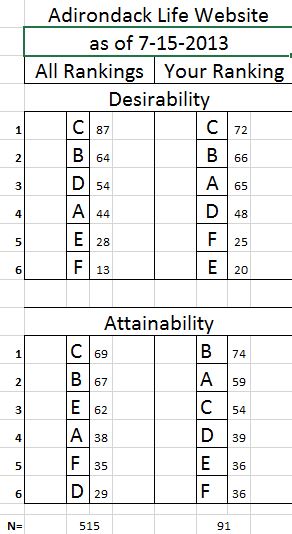
In addition, we published a condensed version of the six endstates in Adirondack Life this spring with a link to the magazine’s website where readers could do the ranking exercise. Although hundreds of people started the exercise, only 91 completed it.  These rankings are shown in the table below.  C and B are still the top in desirability.  But the Wild Park (A) ranks third instead of fourth with this group.  Also Adirondack State Forest (F) got a slightly higher score and is fifth instead of sixth.  The attainability ratings are very different with Sustainable Life (C) is only third.  Wild Park (A) again ranks higher than in the workshop series.

These results are similar to those of two half-day workshops we did during 2012.  One was with a group of seasonal residents.  The other was a group of Paul Smith students in a land use planning class.  The Wild Park scenario was an attempt to capture the point of view of a person who doesn’t live in the Park and is not involved in the issues of economy and community building in the region.

adk life ranking results

These two data sets overall continue to support the consensus vision that is based on the Sustainable Life (C), with a sustainable version of the Usable Park (B), and continued protection of the Forest Preserve as a Wild Park (A).

What We Learned at the Clean Energy Conference

NCCECWe spent the past couple days at the North Country Clean Energy Conference sponsored by ANCA.  It was a great opportunity to learn a lot about a wide variety of approaches to energy conservation, generation and regulation.  We came away amazed by the creativity and innovation that is happening in the energy sector.

Here are a variety of things we learned at the conference.

Public Projects Everywhere

Many municipalities have implemented or are in the planning stages for clean energy projects, typically putting in solar cells to generate electricity (known as photovoltaics or PV systems) or biomass systems for heating.  There was a presentation by Fred Monroe about their positive experience with PV in Chestertown.  Fred noted that even though some of their PV systems are installed at the side of the school playing fields, the panels don’t break when hit with a baseball or soccer ball.  It’s good to note they are pretty rugged.  Another presentation showed how a number of towns along the St. Lawrence River (Ogdensburg, Clayton, Gouvenour and others) have collaborated on a single contract to procure and install PV systems at 15 to 25% savings.  The Thousand Islands Central School also participated.  The projects are pitched to residents as a way to save money and stabilize energy costs.  The  green benefits are a plus but not the motivator.

Biomass Bandwagon

Biomass energy is widely accepted as an important way of reducing fossil fuel use.  There were a number of projects described, the largest of which is the major ReEnergy conversion of a coal-fired power plant to biomass fuels at Ft. Drum.  You can argue about whether using biomass to generate electricity is wise as a general policy due to efficiency issues, but this reuse of an existing facility seems poised for success.  The plant went operational just over a month ago and has been harvesting wood since February.  The key point is that ReEnergy’s commitment to sustainable harvesting of biomass is real and serious.  For example, they are buying state-of-the-art logging equipment and leasing it to some of their loggers supplying the plant so that they can do low impact collection in the forest. They are also in the midst of planting thousands of acres of shrub willow, which can be harvested sustainably every three years. This facility is able to generate enough electricity to meet the needs of 55,000 homes.  It will be an important part of the Army’s commitment to move to more renewable energy sources.

There was also a very impressive presentation on the North Country School’s use of wood for heating using a variety of different technologies and fuel types from cord wood to pellets to chips.  They are currently saving over $50,000 a year in fuel costs.  They are also doing other things to reduce energy use such as switching to LED lighting, green roofs and some PV systems.

The success of biomass in larger, institutional applications has not been matched by success in the residential arena.  There are many concerns about the viability of home biomass including issues of safe storage of pellets and emissions profiles.  Overall, there remains significant prejudice against heating with wood in the general public, some of which derives from old wood furnaces that do belch smoke and particulates and would create a public health problem if used even more widely.  But the new biomass furnaces are very different and the technology is able to lower emissions levels below heating oil.    More education on why the new technologies are clean, safe and carbon neutral is still needed.  It was suggested that NYSERDA set aside a percentage of all grant funds for outreach and education.

Looking at the longer-term effects of major use of biomass, we see nothing but benefit to the North Country.  Developing a new and growing market for wood from our private forests is necessary to counter the steady decline in demand for wood for pulp mills as paper use tapers off – biomass energy will keep our logging industry viable.  The low-grade wood that feeds a pulp mill is equally suitable to feeding a pellet plant.  Biomass collection can also be a cost-effective adjunct to existing harvesting for saw logs, using tops and branches.  Sustainable harvesting of low quality trees from a forest can improve the value of the forest over time, reversing the decades of “high grading” that has occurred in many of our norther forests.

Solar: Do I Have a Deal For You

There are lots of companies out there that want to bring you no-money-down deals for converting to PV or biomass.  The idea is called operational financing.  The company essentially funds the capital cost of the system using the savings from the project.  Usually the company buys the equipment and then enters in an agreement with you to sell you the power or the heat they generate at a reduced price over what you are paying now.  But the majority of the savings go to pay back the install cost.   For schools and municipalities, the company can take benefit of the tax incentives that non-profits cannot use, further increasing the attractiveness of the deal for all.  It appears that more companies are entering this green energy financing in our region.

The State is setting up a billion dollar “green bank” to provide wholesale funds to companies that would set up individual deals with businesses, municipalities and maybe even home owners.  If you have the capital to invest on your own in these green technologies, then your savings will be bigger and start accruing immediately.  But if you don’t, the operational financing approach allows you to make the conversion, go green, and get some savings.  For many, a stable, known cost of energy is a benefit even if it doesn’t represent huge savings off today’s prices.

Community Net Metering Is a Game Changer

There was a lot of talk at the conference about a regulatory change in the works that is called Community Net Metering.  The current situation for someone that installs a PV system is that the electricity produced is fed back into the grid through your own electric meter.  The energy you produce is netted out against what you use, watt for watt,  hence the term net metering.  In this way you can actually reduce your electric bill to zero (but not below) if you have a large solar array.  But the panels need to be near your meter.

Community net metering (also called Virtual Net Metering) allows the solar panels to be remote from your meter, tied into the grid at a different location through a different meter, and yet have the electricity generated net out against what is billed through your own meter.  The purpose of such a set up is to establish a community power production facility and allocate the energy produced to various subscribers and have them get the same benefits as if the energy production was co-located at their personal location.  This program is funded by on charge on everyone’s electric bill, so this is a way to allow everyone to benefit, even a house in the woods.

The immediate implementation would be community solar farms where a large number of solar panels are located at one place and individual home owners or businesses can subscribe to the service.  This would allow buildings that are not favorable for placement of solar panels to benefit from a conversion to solar energy.  A prime opportunity is set up one of these solar farms on closed town land fills.  You can’t build on these landfills but you can put solar panels on them (since the panels are designed to go on roofs, they can easily be sited on a capped land fill without having to penetrate the earth).  It is estimated that only about a quarter of all homes in the US are suitable for placement of solar panels.  So this kind of community set up could unlock a whole new round adoption of PV technology.

But the idea could apply to other forms of alternative power generation too.  If you were the operator of a hydro facility such as the one in Wadams or St. Regis Falls, you could use this community net metering to directly sell your power to nearby customers rather than just wholesaling your power to the grid.  Towns in Europe buy a large wind turbine and allocate its power to individual homes in a similar fashion.

The community net metering approach is fully operational in Vermont and Massachusetts and more restrictive versions of it are in use in a few other states.  The bill (S.4722-2013) before the NY State Senate to enable this is modeled after the one in Massachusetts.  There are many details to work out but there is hope that this can be approved before the end of the year.  Betty Little, our Senator, is the sponsor of the bill and needs to get email supporting S.4722:  little@nysenate.gov

New York State Strongly Committed to Clean Energy

NYSERDA, the New York State Energy Research and Development Authority, is funding all kinds of research and development in clean energy, especially solar.  They are funding utility-scale solar generation projects of multiple millions of kilowatt hours as part of the effort to increase the amount of energy produced from renewables in the State.  The old Benson mines site in Clifton-Fine could be a great site for such a utility-scale solar array.

The State clearly has more policy changes planned in the energy arena.  There is a strong commitment to moving to more distributed power production both to lessen the need for further investment in long-distance transmission but also to improve reliability.  It feels like the 1970’s when we started to dismantle the old, centralized telco systems in favor of distributed systems oriented toward high-speed data. We will see the energy industry move away from centralized, large-scale generation to a more diverse approach that features many distributed generation approaches.  Policy needs to be set so that the existing large players don’t impede progress toward a more flexible and reliable approach.  Distributed power production makes a great deal of sense.

The Zero Waste Stream Company.  Casella May be in Our Future

Some of the presentations drove home the idea that moving to clean energy has positive business benefits.  You save money, improve your image, and possibly participate in new market opportunities.  There was a great presentation by Casella, the waste management company headquartered in Rutland VT and operating for our region out of Plattsburgh.

Because of their large-scale investment in single stream recycling or what they call zero sort, recycling levels at their customers go up typically by 25%.  They really accept almost everything and make it as easy as possible.  But their commitment to sustainability is company-wide. For example, they are converting their truck fleet to compressed natural gas (CNG), which is a huge improvement over the diesel engines  in terms of cost, emission, sound levels.  They are also collecting the methane generated at the 7 land fills they operate and using it to generate electricity or heat a nearby building.  Next, they want to use it to power their CNG truck fleet.  Capturing this methane not only displaces other fossil fuel use but it also prevents this very powerful green house gas from entering the atmosphere.

New Micro-Hydro Technologies Coming

There were presentations about a couple of new micro-hydro technologies that can generate steady streams of electricity in smaller stream situations.  One was called Hydrocoil.  It is a turbine designed to fit inside a 6 inch or 12 inch pipe and generate 1.5 to 2 kW.  It has many applications.  You can put it directly in a stream or feed it with a pipe on land.  But you could also use it in the pipes draining water out of a water tower or in a large building.  Imagine all the potential energy that could be tapped with a simple, flexible, plug and play technology such as this.  This company is still trying to get financing so that they can scale up for production.  They are located in Potsdam and expect to actually manufacture in the north country.

Do you have an old, unused, spring house on your land?  Or a small brook?  There was another, much smaller scale, micro-hydro system presented that would be suited to these situations.  It was incredible simple.  The presentation on it is found here.  Look at the one called “Big Energy from Small Systems”.  We have seen something like this before, called the Stream Engine, from Canada, but this is from Morrisville State College, part of the SUNY system.

Biodigesters in Dairy Land

Although we didn’t spend a lot of time in sessions on the topic of biodigesters we did learn that the main application here is likely to be on dairy farms for processing cow manure.  These systems can generate power that is fed right back into the dairy operations, reducing the waste problem and lowering energy costs.  With the growth in dairy farms, there should be a good market for this technology.

Electric Vehicles have a Big Future

There were hints that electric vehicles (EVs) will be part of our green energy future in the North County.  Although general purpose use of them is still not viable, there are situations where they make sense even now.  North Country school converted a big dump truck to a smaller electric vehicle that the use on campus to transport trash and other materials on the campus.  The mainstream EVs like the Chevy Volt, the Nissan LEAF, and the Mitsubishi i-iEV have a range of at least 60 miles now and are suitable for many people’s daily commute.  If you have solar panels generating your electricity and you use it to charge your EV battery every night, then you can include the gas you didn’t use in your calculations on payback for the solar system.  Gas is a lot more expensive than electricity (you almost certainly spend more per year on gas than you do on electricity) and hence using your PV to charge your EV instead of just offsetting your electricity bill represents a much higher value application.  It can cut the payback period for your panels in half.

Over time batteries will improve further and the range of these EVs will increase somewhat.  If we have a large number of EVs someday (20 years from now) their batteries could become an important part of the way the distributed grid operates.  Turns out that a fully charged EV battery could power your house for a number of hours.  No need to spend on a backup generator any longer.  The grid could use all these batteries for load leveling, charging them up when it has extra capacity and drawing on them to meet peak needs.  All this would have to be managed by very sophisticated software that took into account individual preferences and constraints, but it could be done.  Next year’s Clean Energy Conference will feature an entire track on transportation and how we move off fossil fuels there.

Thank you to ANCA and conference director Dan Mason (yes he’s Dave’s brother) for helping us all move closer to a green economy.
Feels Like Progress

In the past few weeks we have attended Local Government Day, Adirondack Day in the Capital, and the Adirondack Research Consortium.  In each case, we were left with the feeling that the Adirondacks is moving forward on many fronts.  There is a sense of optimism and progress.  Most importantly, collaboration and Park-wide thinking are the rules of the day.

Local Government Day

This is an annual event co-sponsored by the APA and AATV (Adirondack Association of Towns and Villages).  Usually this event happens in March when we are away but they moved it into late April this year and we were pleased to be able to attend.  The senior management from both DEC and APA were there listening hard to the large number of local government reps who came.  The Adirondack Partnership and its Director, Bill Farber, were front and center touting their new Economic Strategies development project that has been awarded to a group of consulting firms led by River Street Planning and Development of Troy.  This project will take the work of the ADK Futures project as a starting point to develop much more detailed strategies for economic development in the region and test them against market data.

The main focus of the day we attended was the economic potential of tourism. There was a presentation by Jim McKenna on the about-to-be-released Adirondack Park Outdoor Recreation Strategy, which is the product of a 25 person volunteer team comprised of public, private and non-profit leaders.  This effort has characterized the main factors that hold back better development of the Park’s resources to provide more economic opportunity to the towns and villages of the region.  The group made it’s initial priority the development of a web portal to bring together all information about recreational opportunities, facilities and visitor amenities across the entire Park.  This is aimed at what the team saw as a key problem: inadequate information available to prospective visitors about the diverse recreational opportunities in the Park and the poor distribution of activities and events across the entire area.  This web portal was recently funded in this years Regional Economic Development grants and its development has already started.

Next we heard about the potential economic benefits of better developing the recreational opportunities of the Park.  Most importantly, we learned how the five towns (Newcomb, Minerva, Indian Lake, North Hudson and Long Lake) affected most by the new NYS acquisition of Finch Pruyn lands are working together to come up with plans for developing recreational and visitor facilities to capture some local economic benefit.  The Nature Conservancy (TNC) has included a half million dollar grant to the towns to help in this effort.  DEC is working closely with the team, too.  This kind of partnership is a major step in the right direction and TNC, in particular, should be commended for their efforts to insure that all benefit from the biggest addition to the Forest Preserve in 100 years.

Overall we heard that there is great potential if we diversify the offerings to visitors, most of whom only want a 1 to 2 hour hike.  This means diversifying access and making it possible for the less fit or elderly to enjoy a portion of the outdoors. Others want something other than hiking, such as biking, boating, etc. Visitors also consider sight seeing, relaxing, dining and shopping an important part of their vacation.  Grassroots efforts to develop new activities are also key, such as the Cranberry 50 development of hiking trails.  In the end though, there needs to be investment in lodging if we are to unlock the economic potential of the region.  We need to think hard about the kinds of incentives and grants that can be put together to attract the necessary private investment.  Our relatively short visitor seasons and increasingly iffy winter weather make these kinds of investments very risky and they won’t happen if local and State government don’t sweeten the pot.

What struck us overall about the event was the lack of griping and pointing fingers.  Instead there was a refreshing sense of optimism and cooperation.  The ADK Futures project was cited repeatedly as one more sign that we are in a new era in the Park, one in which we are moving forward.

Adirondack Day

April 29 was the first Adirondack Day in the “well” of the State Legislative Office building in Albany.  Groups around the State use this space to promote their region or cause to legislators, their staff, and executive branch staff.  With an incredible outpouring of volunteer support, our region pulled together rich  displays about conservation, fighting invasives,  recreation, culture, history, and our successes on the economic development front.  Most prominent, though, were the displays and samples of our burgeoning local food movement.  It was great to see so many of our key organizations working together to promote the entire region.

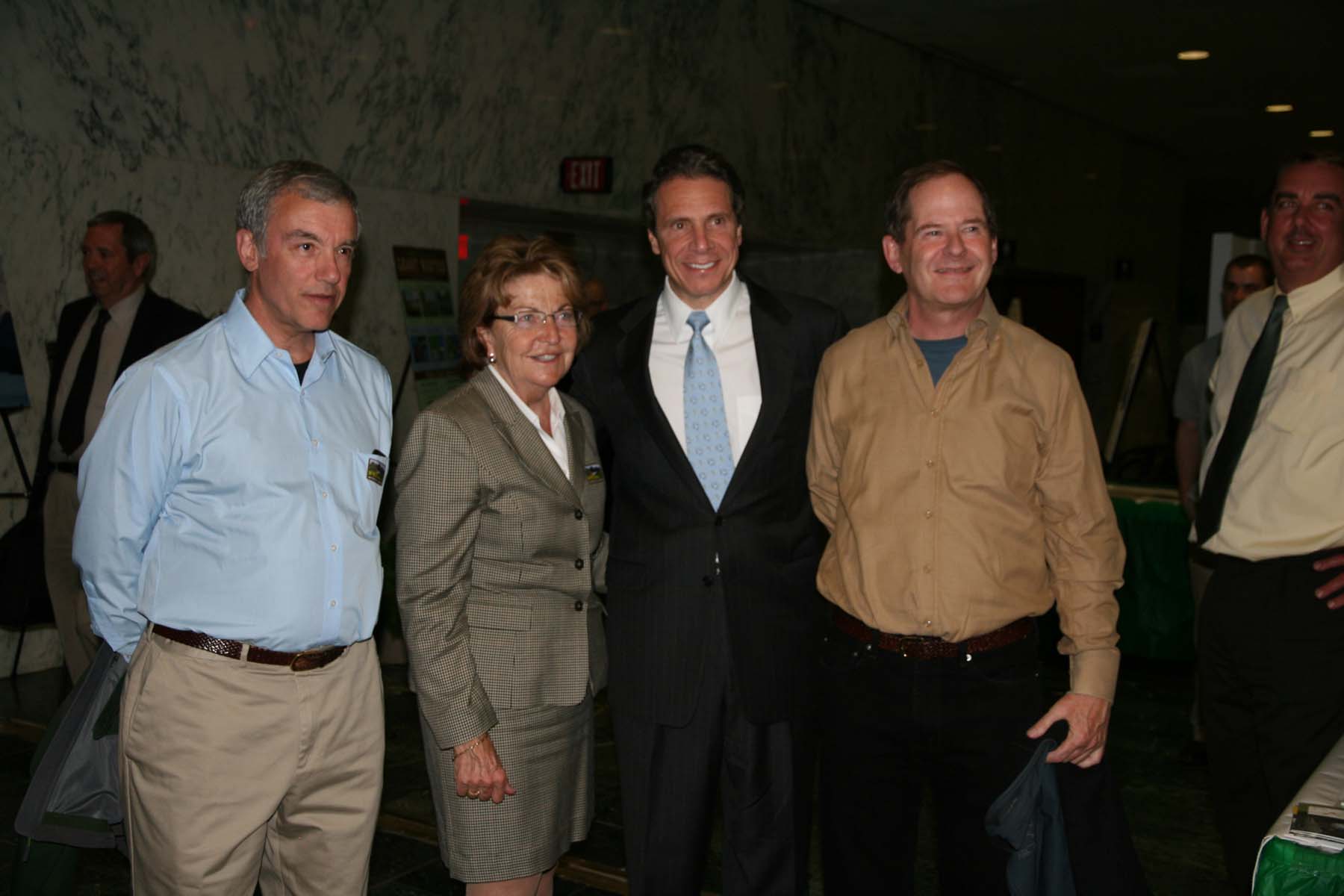
It turns out that this very day the Governor announced his White Water Canoe Challenge.  The effort clearly paid off in terms of greater awareness in Albany to the many ways the Adirondacks are moving ahead these days.  At one point, Mr. Cuomo did make an appearance accompanied by Senator Betty Little and visited a number of the displays. Betty spotted us and steered the Governor our way for a brief introduction.

Jim and dave with Cuomo and Little

Adirondack Research Consortium

Last week we participated in the Adirondack Research Consortium (ARC) conference in Lake Placid.  The opening keynote speakers were Andrew Revkin author of “Dot Earth” blog on the New York Times, and Stephen Jackson, Director of the Southwest Climate Center.  Both held balanced views on climate change that emphasized the adaptability of nature and avoidance of extreme points of view.  Dr. Jackson showed fossil data that indicated fast and major swings in climate have hit the planet before and had nothing to do with humans.  Although we are clearly the major factor driving climate change now, we are not the only part of the system that can do so.  Mr. Revkin introduced the idea that all environmental thinking must now include humans as part of the system, part of the solution and he pointed to the Adirondacks as an example.  Getting to a pre-human wild state is simply not possible.  For better or worse we are like gods, but as Stewart Brand said, “we better get good at it”.  He made the point that climate change is a big messy problem with humans right in the middle of it and the Adirondacks are a big messy problem with humans in the middle of it.  Dr. Jackson also talked about the need for researchers to learn how to better communicate and engage with the public.  Scientists need to understand the public doesn’t react to data the way they do.  In general, data never changes anyone’s mind. We need more people and organizations that are boundary spanners, that can bridge gaps between researchers and stakeholders.  The Adirondack Research Consortium is one of those.

Bob Stegemann, DEC Region 5 Director, next stepped in for Joe Martens, DEC Commissioner, who had to be at a meeting with the Governor that day.  Bob’s message was that the Adirondack’s are doing better than they have in many decades.  We are completing the largest addition to the Forest Preserve in 100 years and all 26 town boards affected agreed to support it.  And in the past 20 years we have added nearly 800,000 acres of easement lands inside the Blue Line.  But, he emphasized, the towns and villages now need to thrive as the Forest Preserve has thrived.  We need to work harder to ensure that the State land benefits local communities.  We need stronger communities if they are going to be able to adapt to climate change and the more severe weather it is going to throw at us.

Bob also pointed out that as the Forest Preserve has grown (it is four times as large as it was when Article XIV was enacted) the issues for towns and villages with regard to the Forest Preserve have grown.  He argued for consideration of an expanded transportation land bank to cover county and town roads.  The current one only covers State highways, but they are not the only ones with bad curves, utility poles that are hazards, culverts that need upgrading, etc.  He also suggested that a utility land bank be considered to enable modernization of existing utilities where Forest Preserve prevents siting of power, communications, water and sewer lines.  We, too believe that carefully crafted and vetted versions of these ideas could be effective win-win modifications to the existing regulatory strictures in the Park.  He also encouraged passage of the Transferable Development Rights (TDR) bill before the legislature and that more towns use APA map amendments to implement community development proposals.  He ended by emphasizing the threat the invasive species pose to our great Park.

Next there was a panel of energy industry executives, but I must admit to not really learning much that was new, except that the big generators are concerned about the “threat” of distributed power production.  We are so reminded of the way the Internet threatened the old, stodgy telcos.

Day 2 of the conference was kicked off with a panel of Dave Mason, Steve Englehart of AARCH and Kate  Fish of ANCA.  In keeping with the theme of the conference, Dave presented the 25 year future vision developed by our project.  Then Steve provided the historical perspective on how the vision is rooted in our traditions and out landscape.  Kate then talked about all the projects and efforts that are moving us toward the vision, emphasizing the two big wins for the North Country in the Regional Economic Development Council process.

In response to some questions after the talk, the Futures Project with CGA agreed to compile suggestions for a research agenda for the region as input to the Consortium.

This was our third ARC and this one was very different in tone and substance from the first one we went to in May 2011.  We were just starting our research about the Adirondacks for the Futures project.  The final plenary presentation that year was about the APRAP report, all doom and gloom.  That effort provided an important baseline of data, but it didn’t point to a way out of the funk we were in.  When we were doing our strategic planning consulting back in the ’90s, we found over and over again that data, by itself, doesn’t usually change people’s minds or lead to action.  People use data to support what they already believe.  To make progress you need to get people to let go of past beliefs and assumptions, to unlearn them as we used to say.  Until you can crack open the current belief system or mental models of people, they can’t look afresh at a situation and see the possibility of positive change.  We may be seeing that happen now.

What is happening to boost tourism?

There are lots of projects aimed at visitors

A group that was hatched at Common Ground to write a Park wide recreation plan has completed its work and it will be presented at the July 2013 CGA event in Newcomb.  In cooperation with AATV, they received a NCREDC grant ($108,000) to build a new web based  recreation portal for Park visitors to showcase everything a visitor might want to know about the park, indoors, outdoors, all seasons, all over the region.  The goal is to spread visitors around more, use specifically promoted events as season extenders.

A spinoff effort from the same group is working with local people in the five towns impacted by the Finch land acquisitions.  They are charged with coming up with a plan that turns the new Forest Preserve additions into a much needed economic boost for the towns based on recreation.  At the closing of the recent phase of sales to the State, The Nature Conservancy contributed $500,000 to help the five towns with this effort.

Governor Cuomo has set up a Whitewater Challenge, for July 21 in Indian Lake as a promotional effort to bring attention to recreation on the new Forest Preserve land acquisitions.

The are quite a few projects underway aimed at improving tourism facilities using REDC grant funding:

The ADK Mountain Club has $221,000 to upgrade hiker facilities at their Heart Lake facility.  Port Henry on Lake Champlain has $250,000 to rebuild the Bulwagga Bay recreation facilities. Wilmington got $251,000 to upgrade 3 waterfront parks.  Inlet has $248,000 to redesign and rebuild Arrowhead Park.  Northville will see $75,000 in improvements for two waterfront parks.  Tupper Lake and the other communities hosting the 90 mile ADK Canoe Classic will see $445,000 in projects.  Lake George will see new public docks ($170,000) and park improvements.  Lake Placid will build multi-use recreational fields (think Lacrosse) on top of closed landfills.

Also, a $2 million capital loan fund was set up for tourism projects.

Separately, DEC has plans to replace the docks at Second Pond, a heavily used place to put in boats near Lower Saranac Lake.

A big private initiative is construction of a new 100 room hotel in Lake Placid.  The Sagamore in Bolton Landing on Lake George announced it will be open all year and the same owners have purchased The Lake Placid Lodge.  Maybe some hi-end tourism will move people around the Park?

DEC has opened a new 12 mile inter-hamlet trail between Inlet and Raquette Lake for snowmobiles, hikers, bikes, etc.  At the same time, DEC closed 2 miles of road and 46 miles of back country snowmobile trail, and then the APA reclassified 15,000 acres as wilderness instead of wild forest.  Protect thinks accommodating today’s machines that groom snowmobile trails are illegal, so they sued the State.  It is not clear how the suit will impact other inter-hamlet trail projects.

The Rail-Trail debate has stepped ahead.  The State DOT will open and review the plan for the Utica-Lake Placid rail corridor.  This could take a year or two.

Use of the back country, at least by people intent on becoming 46ers, is doing well.  So well in fact, that the volunteers that run the 46er club say they added 412 people to their 7000 members in 2012 alone.  Saying it is now too much work, they are changing their policies.

Lake George, Lake Placid and Saranac Lake are all working on Main Street revitalization plans.

If we were to name all this diverse activity it would be the “Whole Park Tourism Initiative”.  By “whole” we mean geographically but also indoor as well as outdoor recreation, accommodations, places to shop, eat and so on – the “whole visitor experience”. The big change is to promote the broad scope of possible experiences for visitors to the region, putting emphasis on the scale and scope of the entire region.

And, in the “never going to happen” category…

It is clear now that, other than specific fees for, say, a campsite, ski pass, fishing/hunting license, or a bed tax,  there will never be a general ADK Park user fee.

But, one day, there may still be a no-fee system to limit the flow of people in crowded places at peak times – a free system (e.g. Cascade Mtn or some boat launches).  If you want an example of this, check out how free admissions to the 911 memorial in NYC are handled.  Here, you could get the permit off the internet and wear it on a trail, like you do a ski pass, hunting license, etc.   This isn’t needed all over, just is busy spots, just in busy season.

The Village of Lake George and, separately, Essex County have sent notice to the Governor’s office that, if casinos became legal in NY, they would be interested in being a site for one.  Since then the Governor signed a deal with the indian casino that leaves the with the exclusive gaming location in the 8 northern counties.  So we won’t be seeing a casino in the Adirondacks.

North Country Sustainability Plan

On January 23 we attended the summary presentation of the North Country Regional Sustainability Plan at the Wild Center.  This is an effort out of NYSERDA, modeled after the Regional Economic Council process, to create an overarching plan for improving the economic and environmental health of the State.  Like the broader economic councils, this effort was organized at the level of 10 regions across the State.  The North Country effort was led by Essex County and included Hamilton, Clinton, Franklin, Lewis, St. Lawrence, and Jefferson counties.

The place to start is with that over-used word sustainability.  The key idea is that our communities, economy and Park lands are managed and used in such a way that finite resources are conserved and reused so that they will be available to future generations. This includes finding ways to be more efficient, i.e. using fewer resources, as well as using more renewable resources like the sun. Implicit in this definition is the need to limit green house gas (GHG) emissions which are the root cause of climate change and tied to non-sustainable use of fossil fuels.

But sustainable, especially when applied to our communities and economic systems, also carries the connotation of strong, resilient and self-reliant.  When it feels like many of our Adirondack towns are shrinking, sliding into oblivion and need regular infusions of aid from Government, the economy doesn’t feel very sustainable.  One professor from Paul Smiths, Brett McLeod, suggested we talk about creating durable communities.  We like that and suspect it will go over much better with many North Country residents than sustainable, which unfortunately is also associated in some people’s minds with liberalism, climate change and a plot by the UN to take over all private property.

The sustainability plan, whose development was led by the team of ANCA and the consulting firm Ecology and Environment (E&E), was based on two main pieces of input.  The first was a detailed inventory of current green house gas emissions in our region.  This will serve as a baseline for both prioritizing future efforts and for measuring success at reducing our use of fossil fuels.  The second input came from a fairly large-scale public outreach and stakeholder engagement effort.  We participated in a couple of working group sessions as well as a major input session that brought all seven working groups together in an information sharing day.

The GHG inventory has lots of interesting data and some good news for our efforts to become a greener economy.  Because of the large amount of hydro and wind based generation of electricity, primarily in the St. Lawrence river valley, 94% of the electricity that flows through the power grid is generated from renewable sources.  This doesn’t include the electricity that is generated by small-scale solar, wind or geothermal.  This is a great place to start on a sustainability plan.  Looking at our non-transportation energy use, 30% of the energy is produced by wood for heating, but this only contributes 1% of the GHG emissions.  Meanwhile, fuel oil represents 35% of our energy use but contributes 48% of our GHG emissions.  Similarly natural gas is 30% of energy use and 40% of emissions.  Thus, a major strategy is to substitute biomass heating systems for those based on fuel oil and to some extent natural gas.  At the residential level, there is a lot to be gained by converting the 39% of homes heating with fuel oil to high-efficiency wood burners, and this is a centerpiece of the ADK Futures strategy.

The real problem is in energy use for transportation, which accounts for 40% of our GHG emissions (residential energy use accounts for only 17% of the total) and 42% of per capita energy consumption.  Three quarters of this is for basic cars and trucks on the road.  Farming, forestry, snowmobiles, ATVs and recreational boating account for 21% of transportation-related emissions.  Strategies for reducing emissions due to transportation are much less clear as our large distances in the North Country require a lot of driving.  Long-term efforts to encourage clustering of both businesses and residences in towns can help to promote walking, biking and use of electric carts.  Unfortunately, the data says that in our region, the number of people living in a city or town center went down from 53% in 2000 to 46% in 2010.

The real key will be getting people to use alternatives to single occupant vehicle traffic by building up bus systems and creating support systems for ride sharing. Surprisingly, the study estimated that 18.5% of commuters in the North Country travel via car pool, public transit, biking or walking. Presumably most of this is in the larger towns and cities outside the Blue Line.

In our view, the GHG emissions due to transportation within the Blue Line can only come down significantly when we have affordable electric vehicles that have sufficient range to meet the needs of our dispersed region.  Since our electricity is almost entirely based on renewables, this can be an effective long-term strategy.  Use of biofuels may also be significant if technical breakthroughs increase the efficiency of their production.

The stakeholder input effort was organized into seven working groups with overlapping and inter-related issues:

  • Energy
  • Transportation
  • Livable communities and land use
  • Economic development
  • Materials management (i.e., recycling as much waste as possible in an energy efficient  way)
  • Water management
  • Working landscapes (agriculture, forests, recreation)

The proposals in these groups are very similar to those developed through the ADK Futures process:  encourage more local food and local energy production, cluster development in town centers, use the land productively but in a sustainable manner for farming, forestry and recreation, protect the quality of our water, plan at the larger level of watersheds, use new technologies for water treatment that are energy efficient, and increase reuse and recycling of waste, especially for organic waste through composting and digesters.

The data again has some interesting points.  Energy usage by farms has not been a focus before and there is great potential to make them more efficient as only 1% of farms have ever done an energy audit.  Although our solid waste disposal per person is 22% less than the State average, we are 4x less effective at recovering materials from the waste stream.  DEC currently estimates that a quarter of the water bodies in the North Country are impaired in some way with pollution, invasives, acid rain, etc.  34% of North Country communities are considered “food deserts” by the USDA, i.e., you have to travel over an hour to get to a supermarket.

We certainly applaud this major effort and look forward to seeing it refined into more concrete proposals for new investment, education and incentives from the State.

2012 Regional Economic Council Awards

How the 2012 REDC Projects Line Up to ADK Futures Implementation Plans

The Regional Economic Development Grants for 2012 were announced just before Christmas and they support numerous efforts well aligned to the ADK Futures implementation work.  The ADK Park is part of 3 REDC regions.  A summary of ADK grants in all 3 follows and at the end there is link to the 2012 grant details.

Broadband Projects

Almost $2.1 million in grants to bring broadband to Long Lake and the rest of Hamilton County were awarded.  In addition, $2.2 million was awarded to interconnect public emergency and 911 centers across the region.  We can see the light at the end of the tunnel on the broadband problem.  A $500,000 loan fund will also support last mile connections.

Tourism Projects

The Wild Center in Tupper Lake won $1 million to develop an elevated boardwalk in the tree canopy at the site. Tupper Lake will also see $36,000 to redevelop and old hotel and restaurant.  The ADK Museum exhibition upgrades were granted $50,000.

The ADK Mountain Club will see $221,000 of improvements at its Heart Lake facilities.  Restorations at Great Camp Sagamore, $239,000.  Warren County, in a Hudson River regional coordinated effort, will see $308,000 for a new park, a restored bandshell. and design of a new Corinth train station.

Improvements to the Indian Lake Theater got $63,000 and digital conversion of the Old Forge theater, $25,000.  The new touring ADK Lakes Summer Theater Festival received $150,000.  Traditional Arts in Upstate NY and ANCA received $190,000 to support collection management, artisans and retailers.

AATV received $108,000 to develop the ADK Recreation Web Portal, showcasing recreation activities and amenities across the whole Park.  Lastly, the ADK Economic Development Council will manage a $2 million tourism fund for the region.

Waterfront Improvements (mostly also tourism)

Implementation of waterfront tourism projects in Essex and Clinton Counties, $700,000.  Reconstruction of Bulwagga Bay recreation facilities in Port Henry, $250,000.  Improvements to 3 waterfront parks in Wilmington, $251,000.  Arrowhead Park in Inlet will see redesign and construction, $248,000.  Tupper Lake, along with other communities hosting the 90 mile ADK canoe classic will see $445,000 in projects identified in the Raquette River Blueway Plan.  Northville will see two parks on the lake front improved, $75,000.

Lake George will see new public docks ($170,000), improvements in the park ($750,000) and a whole Gateway Improvement Project aimed at improved water quality, walk-ability and safety in the Village for $545,000.

Water Quality

Lake Champlain non-point source pollution management planning saw a $200,000 grant.  Port Henry water and sewer enhancements, $600,000.  Implementation of the Ausable River watershed management plan, $218,000.

In Lake Placid, the removal of the Chubb River Dam and restoration of the river, $1 million, and this is associated with replacing an old sewer trunk line that runs under the lake.

Implementation of an wide ranging Schroon Lake Watershed Management Plan won $300,000.

Lake George will see $390,000 to work on stream corridors addressing storm water runoff and water quality,

An engineering assessment of Corinth waste water upgrades will see $30,000

Also, a $2 million infrastructure fund for water, sewer, roads and ports across the whole region.

Local Food Projects

A much needed, small, USDA slaughterhouse in Ticonderoga got a boost with $465,000.  A USDA mobile chicken processing unit was funded last year and is soon to be operational.

A North Country Food Hub will be established in Canton, $350,000.

A community kitchen and cafeteria training site for storage and distribution of local ag products from Warren, Washington and Saratoga producers, $125,000

Local Energy Projects

Old Forge will build a new biomass district heating project with a grant of $1 million.  Tupper Lake is awarded $300,000 for design and engineering of a new biomass fueled district heating project including Sunmount, the school and other nearby buildings. The ADK Museum pellet boiler project was granted $130,000.

A natural gas line to the IP Ticonderoga paper mill will replace fuel oil, extending the life of the mill, for $1.75 million.

Father afield, the pellet plant in Malone will see $168,000 to improve energy efficiency.  A grant of $470,000 will go to planting willow plantations intended to fuel the soon-to-start-up ReEnergy project at Ft Drum. A super-efficient biomass fueled co-gen plant in Watervliet Arsenal won $1 million grant.  3 separate biomass heat boilers installed in the Albany area, $600,000.

Additional Important Projects

The former J&L mine site Clifton will finally demolish a large building and do an assessment of site redevelopment possibilities, $175,000

In Warrensburg, a new 40,000 sqft primary care center run by Hudson Headwaters received additional grant funding bringing the total to $7.5 million.

The Town of North Elba and the Village of Saranac Lake won a $463,000 grant to develop a comprehensive plan addressing parking and traffic, worker housing, marketing, diversification of economic activity and construction of multi-use recreational fields on top of closed landfills close to their downtowns.

Lake George will begin work on a revitalization strategy for the town, $38,000.

It is important to know that a wide array of projects are in the areas immediately surrounding the ADK Park like Glens Falls, Plattsburgh, Potsdam/Canton, Watertown and Utica.

If we grabbed your interest, we encourage your to read the announcement booklet

The ADK Futures Project is well known to a number of the volunteer members of the Council including the co-chairs, Tony Collins@Clarkson and Gary Douglas@the Nth Country Chamber of Commerce, along with Cali Brooks @ANCA, Randy Douglas@Essex County, Bill Farber@Hamilton County, Kate Fish@ANCA, Jim McKenna@ROOST in Lake Placid, and Senator Betty Little so it is a pleasure for us to see so many projects that align so well to the ADK Futures vision and implementation efforts get funded.

Middle Schoolers’ Endstate

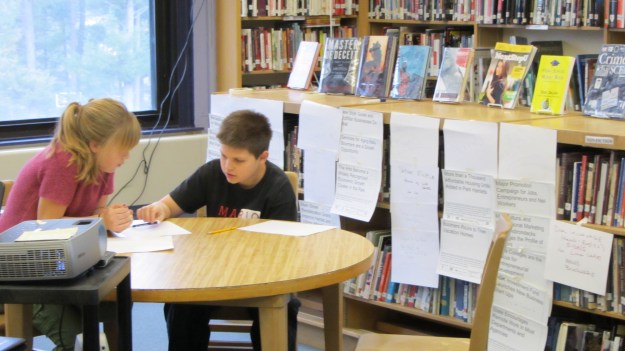
Earlier this month we had the pleasure of facilitating two half-day workshops with the 7th and 8th graders at Long Lake Central School.  The process we used was really the idea of the teachers there.  For the first session, we worked with the students to imagine what a future endstate for their community and school could look like.  We also looked at some of the broader possibilities for the Park as a whole.  For the second session, we had the students think about what events would have to happen to make their endstate come about.  At the end, we asked them to think about the ways in which they could participate in making three of those events happen some day.  The teachers are going to continue working with the students to help them understand what they have to learn during their time in school in order to be able to make those contributions.

IMG_0220

The students were thoughtful and creative and easily engaged with the major issues, such as balancing environmental protection with developing the local economy.  They also wanted more local control and less imposition of rules by people who live outside the Park.  This is the endstate that they came up with.

Long Lake and the Adirondack Park in 2028

A Stronger, More Vibrant Community

More jobs, residents, and families,

A bigger hamlet with a new neighborhood, more buildings

More visitors and retirees, who create jobs by spending money in the community

More jobs in agriculture, logging, light manufacturing, healthcare and using the broadband network; maybe a community college

More services: stores, bakery, restaurants, movie theater, arcade, retirement home, cellphones

Using Greener Energy and Less Fossil Fuel

More renewable energy like solar, wind, hydro and biomass based on wood pellets; the conversion to renewables will generate jobs and save money in the long run

Waste less energy and save money

More electric and hybrid cars, more use of synfuels, especially as gasoline gets more expensive

Revive the rail system

More biking, walking, ride sharing so you use your car less

Government and Adirondack Park policies that support renewable energy including wind turbines

With Smaller, More Local Government

Less waste and duplication.  Share government positions with other towns in the county (e.g., tax collector, highway supervisor, coroner, town and school boards).

More local control: People who live in the Park should have the say over the rules in the Park.  Lessen the role of the APA and let local communities regulate and enforce laws in their own towns.  Let towns modify hunting regulations.

Cut through the red tape and be more self-reliant.  Government that this friendly toward economic growth, that promotes good projects and helps then succeed.

A little bit bigger school that is more diverse, and shares resources with neighboring schools

And That Protects the Environment

Adirondack waters need more protection from invasive plants and animals, storm water runoff from farms and lawns, and leaking septic systems

The Park is large and can support many kinds of recreation, some wild and some not, some with and some without motors.

The people of the community want to protect the waters and forests and wild life of the Park from pollution and over use. Responsible hunting, fishing and logging don’t degrade the environment.

The Role of Manufacturing in the ADK Futures Strategy

A couple of times now when we give our standard talk about the ADK Futures project and the consensus vision, someone asks us why there is no manufacturing in the plan. Although it doesn’t receive strong emphasis, there is mention of manufacturing in the vision.  In the 45 minute version  of the talk it often gets dropped.  But it actually is a big deal.

Many of the areas just outside the Blue Line are experiencing a manufacturing boom.  The Saratoga/Capital region, in particular, is experiencing an incredible high-tech boom in nanotech and semiconductors.  There is the potential for much further expansion there, too.  Meanwhile there is expansion at Bombardier in Plattsburgh and the Army in Ft. Drum and Fage Yogurt  south of the Park in Johnstown. International Paper’s Ticonderoga Mill is in the Park, producing copier and office printer paper. The Finch Pryun mill in Glens Falls produces also produces printing paper.

There are many ways in which the edge towns of the Park that are near these growing areas can benefit from this mini-boom.  Some employees in these new or expanding plants will choose to live in a quieter community with more open space somewhere just over the Blue Line in the Park. Others will want vacation homes in the Park.  Most will at least visit regularly.  The management of some of these new companies in the region may decide to build a Corporate retreat somewhere currently up for sale.  Notice I haven’t even mentioned fracking and its potential economic impact on the southern areas of the Park?

People throughout the Park with broadband Internet access will also be able to participate in various ways in the growth in manufacturing and other jobs in the ring of cities around the Park, as subcontractors and remote employees, or as providers of necessary business back office services.  People can work from home, but also easily show up in the office when necessary.  Some smaller subcontractors may find it cheaper to set up shop in an Adirondack town than in the booming capital region.  With most business interactions being over the Internet anyway, you don’t have to be co-located in the same office Park as your client.

All of this requires getting in front of the people who are hiring and growing these businesses around the edges of the Park in order to promote the region as a place to live, vacation and recreate. Some of the community development organizations around the Park are working on this we’re told. We need to dispel the myth that a business can’t get started inside the Blue Line because of APA and DEC red tape and restrictions. We have industrial parks, waiting. We have a large industrial site in Clifton Fine with fiber trunk line and potentially restored rail freight service.  Information businesses, in particular, should raise no serious environmental concerns.

Inside the Park, we have some light manufacturing that can grow.  Here are some examples. Saranac Lake has several biotech companies.  North Creek has Creative Stage Lighting doing well enough to expand.  In Willsboro, General Composites is a custom manufacturer of hi-end composite components. In Piseco, Wilt Industries fabricates advance annealing ovens to produce, for example, silicon ingots for chip companies like Intel.  Placid Boatworks makes canoes.  Hi-end craftsman make rustic furniture, guide boats and taxidermy.

These are niche businesses.  “Niche” means they are large enough to be real businesses, but their markets don’t attract the 1000 pound guerrillas of industry.  These fit the Park better than large mines and mills, employing many hundreds of people.  When these big business fail or leave, the towns involved crash, often losing 2/3 of their population.  Look at Port Henry, Newcomb, Clifton-Fine – all are case studies.  The Trudeau Sanatorium in Saranac Lake was a huge employer and shut abruptly in the summer of 1954 when effective antibiotics were introduced.  It took decades to the village to get back on its feet.  Light manufacturing, involved in niche markets, is our sweet spot.  But you have to find a lot of them.